How Many People Are Employed by Dia Art Foundation
Re-emerging equally a force in Chelsea after a two-twelvemonth, $20m renovation, the Dia Art Foundation'due south space at that place will reopen on Friday (16 Apr) with a renewed purpose: to champion under-recognised artists and to serve equally an information hub for all xi of Dia's long-term art sites.
The foundation'south Chelsea renovation unites its three contiguous buildings on Westward 22nd Street and underlines its gritty history of inventively revitalising existing structures. The 32,500 sq. ft project, which includes 20,000 sq. ft for exhibitions and other programming, embraces the neighbourhood'southward traditional character and architectural vernacular, with wide-open industrial-style spaces, exposed brick, wooden ceiling beams and rehabilitated skylights that allow natural light to pour in and illuminate the fine art. It also reasserts the foundation's importance in championing long-term art installations that flood the senses.
Dia'southward goal in the revamped Chelsea space is to proceed artists' works on display for as long as nine months or more, beginning with a film and two pairs of light sculptures commissioned from the artist Lucy Raven. Her black-and-white 50-minute picture Ready Mix, shot at a institute in Idaho, records the transformation of minerals and binders into concrete and evokes the historical preoccupation of several Dia artists with the American West; the lights in her sculptures, part of a serial titled Casters, will motility continually in and out of synchronisation with each other in a cavernous space.
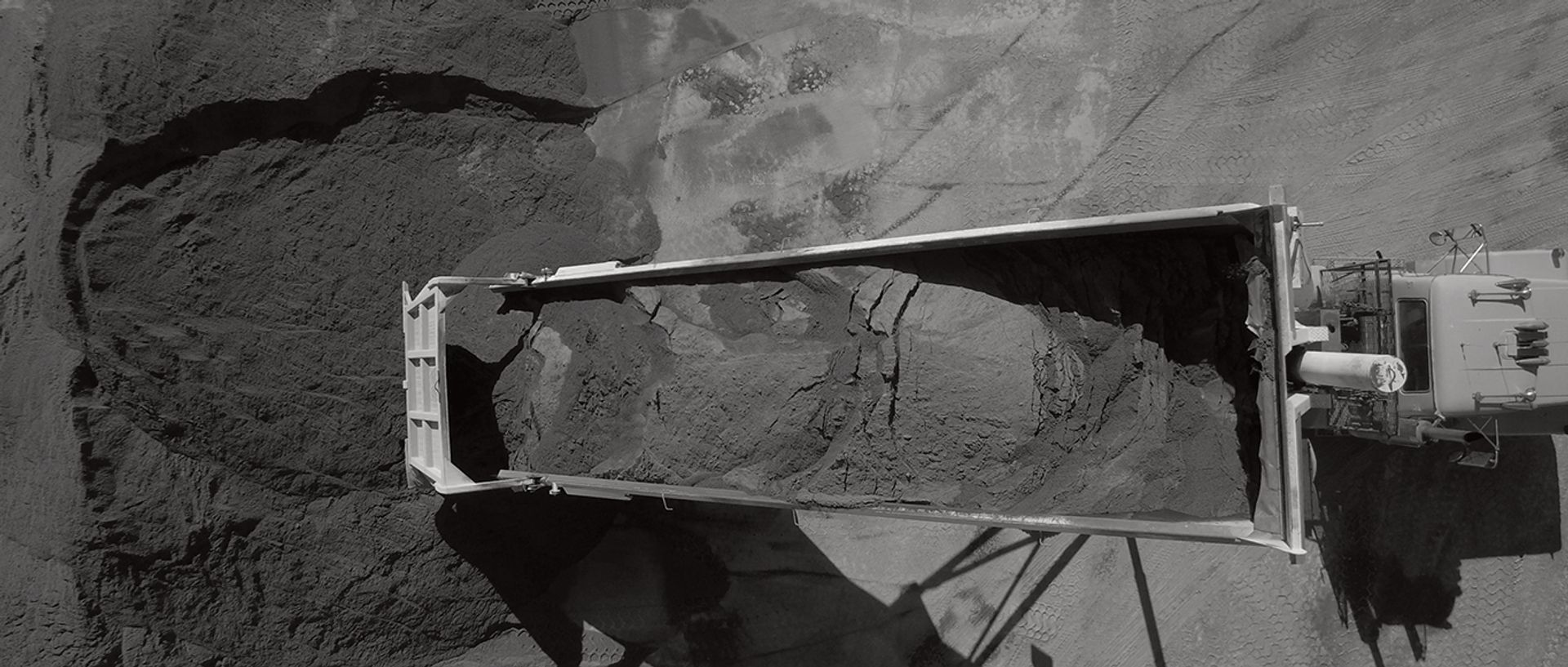
A scene from Lucy Raven's pic Prepare Mix, 2021 © Lucy Raven, courtesy of the creative person, Dia Fine art Foundation, New York
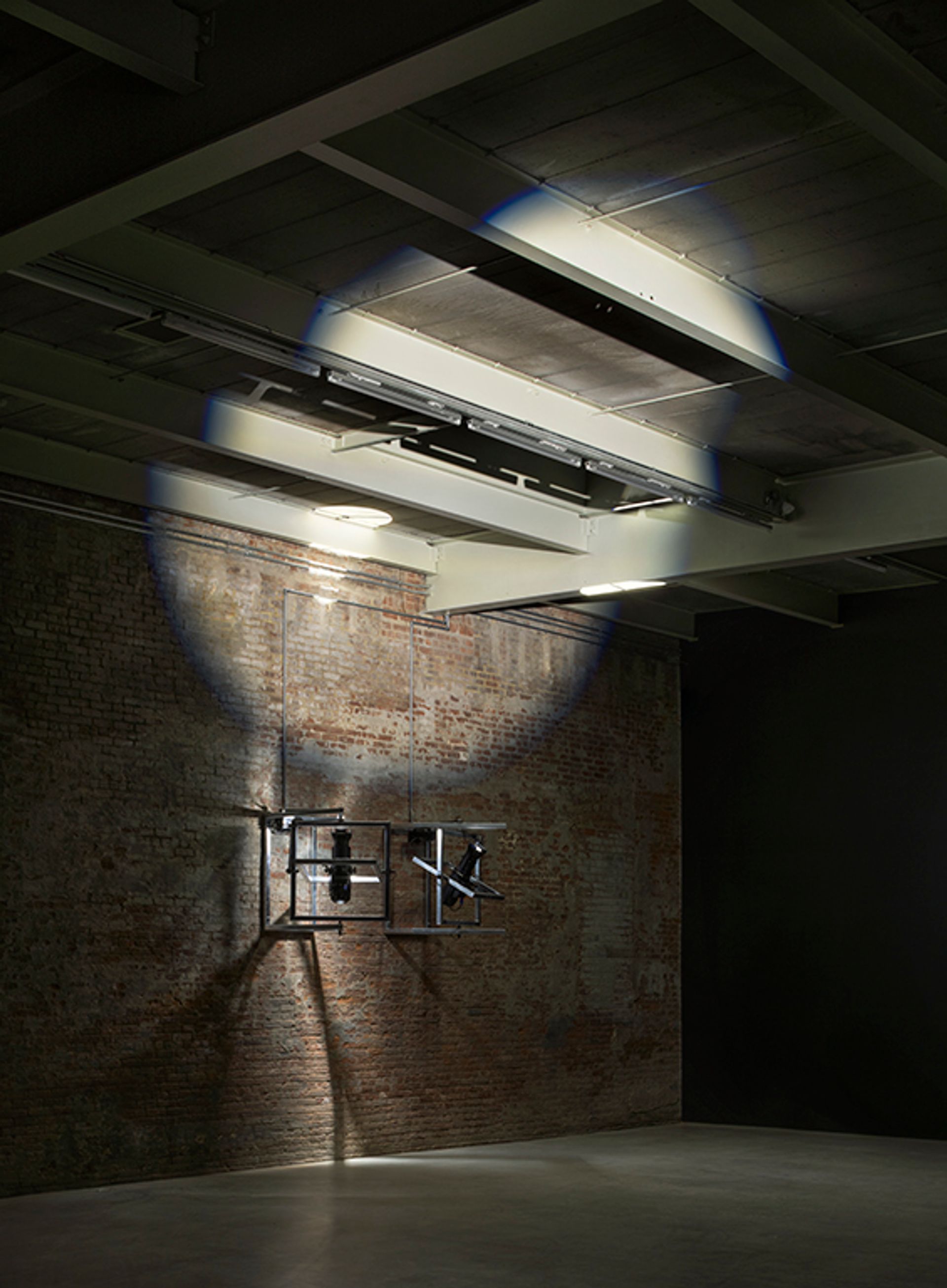
Lucy Raven, Casters X-ii + Ten-3, 2021 Photo: Nib Jacobson Studio, courtesy of Dia Art Foundation
Jessica Morgan, the nonprofit foundation's director, notes that Raven is not represented by a dealer. "Nosotros've always tried working with curators on what artists we tin can make a deviation with," she said in an interview, "what does not align itself then easily with gallery representation for one reason or another, and therefore needs infinite, needs support, needs funding."
For the Dia Chelsea renovation, Morgan says she consulted artists whom Dia had sponsored in the past, including Zoe Leonard and Roni Horn, about their instincts for the site. "They both were very articulate virtually the humility of the industrial spaces that we use: they're non spaces that compete with that work," she says. "They were definitely non encouraging whatsoever motion toward new building," but "rather thinking about what we have and using that nigh effectively."
To that end, Morgan enlisted the firm Compages Research Office (ARO), whose projects take included the restoration of Donald Judd'due south erstwhile residence and studio in SoHo and of the Rothko Chapel in Houston, to lead the pattern and construction while keeping costs down. "They've been merely so thoughtful, simply as well understanding of what our goals were ultimately with the spaces–which was to try and keep them looking as shut as possible to their original state, which isn't necessarily the most heady thing for an architect," she says.
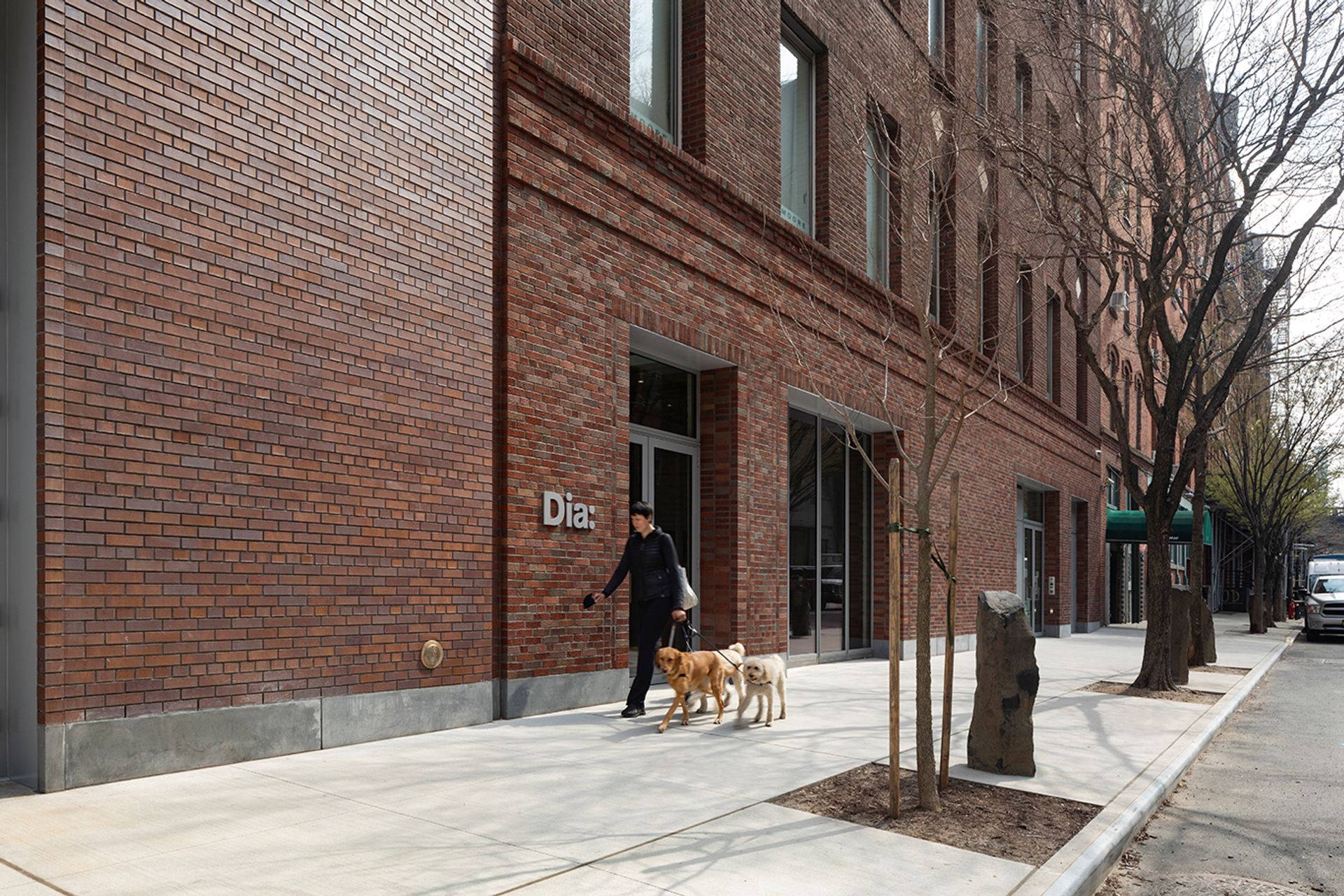
The sidewalk view of Dia Chelsea, with its uniform brickwork uniting iii spaces Dia Fine art Foundation
One result is the cosmos of a united brick façade for all three buildings that evokes the brickwork at Dia Beacon, the foundation's sprawling exhibition space in a converted Nabisco factory on the Hudson River, 55 miles n of New York City. (Two of the Chelsea buildings were purchased in the 1990s, and the one linking them in 2011.)
Two mammoth galleries in Chelsea will operate, and the overall space volition be open even while installations are being dismantled, inviting visitors to a bookshop, reading room, "talk space" and one full storey for educational programming, Morgan says. Office spaces have also been expanded and renovated. The bookshop, a reincarnation of one in a previous Chelsea infinite, celebrates the celebrated office of Dia's publications in promoting its programming as well as more recent forays into commissioning poetry, fiction and critical essays.
Access in Chelsea will exist free, as it is at all of the foundation'southward New York sites; Covid-19 restrictions will nevertheless limit visitors to 25% chapters, and groups are not yet allowed.
ARO is also overseeing projects like the planned renovation of a Dia space on Wooster Street in SoHo, which is at present beingness leased but is destined to be a two,500 sq. ft exhibition venue due to open up in the autumn of 2023; the renovation of two nearby Dia installations by Walter De Maria, The Cleaved Kilometer (1979) and The New York Earth Room (1977), which are likewise due for completion in 2023; and the restoration and expansion of the lower level and surrounding landscape of Dia Beacon, for which no timeline has been ready.
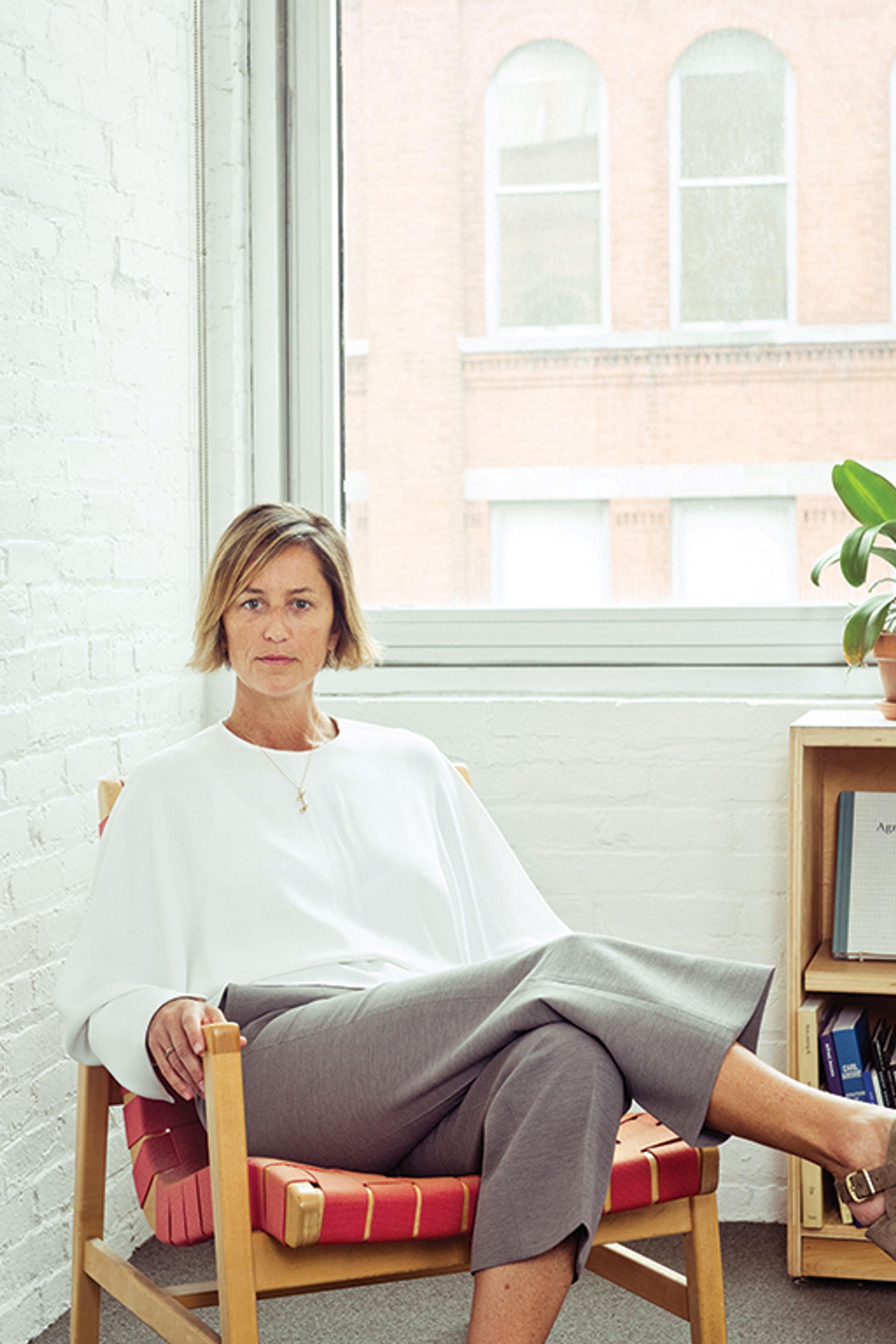
Jessica Morgan, director of the Dia Fine art Foundation Photograph: Gabriela Herman, courtesy of Dia Art Foundation, New York
The initiatives are part of a $90m capital letter fundraising entrada, with $80m raised so far by the foundation, according to Morgan. In addition to financing the renovation and construction projects, the foundation hopes to heave its endowment, currently at $85m, to $100m, she says.
Nathalie de Gunzburg, chairman of Dia'southward 24-fellow member board of trustees, says the board has provided most of the $80m raised so far. "Nosotros're doing quite well," she says, despite the economical downturn precipitated by Covid. De Gunzburg and Morgan both note that Dia is not largely dependent on ticket income and therefore did not suffer from the precipitous pass up in revenue experienced by many fine art institutions.
A forgivable $1.25 m Paycheck Protection Program loan from the federal government helped Dia cover employees' salaries during its Covid-19 closures at various sites final year, de Gunzburg says. After furloughing 86 employees after the pandemic last March, they returned in staggered phases as sites reopened, the museum says, while the jobs of 3 employees in the bookshop, on the curatorial staff and in development, were cut. Morgan says Dia now has 140 employees—"a lean team"—spread over its eleven sites.
The Chelsea opening is an affidavit of the role that Dia has historically played in the area, where the foundation first established a presence in the 1980s. Dorsum then, it was a declining industrial area populated by warehouses and garages, and Dia, Gagosian gallery and the Kitchen were the art pioneers. Dia had a space beyond the street from the buildings it owns now and was a pathbreaker in promoting work by such artists every bit Dan Graham, Dan Flavin and Jorge Pardo.
While Chelsea is of course today the premier weekend mecca for New York gallery goers, some galleries are now questioning their commitment to the area as others decamp for neighbourhoods like TriBeCa in search of more infinite.
Donna De Salvo, the former deputy director and primary curator at the Whitney Museum of American Art, joined Dia last yr every bit a senior adjunct curator for special projects. It was a homecoming for her, equally she had worked as a curator at that place in the 1980s, when Chelsea was "a ghost town", equally she puts it, and Dia led the way for the rest of the art world in planting roots.
She casts the Chelsea reopening as a reaffirmation this history while besides embracing a "continual redefinition and expansion of the artists we piece of work with". Similar the installations and acquisitions at Beacon, in which she is now playing a big office, De Salvo says, "it gives us an opportunity to rethink different histories and write new histories", while endeavouring to "see art in the context of the world".
Founded in 1974 equally a kind of counter-museum that would back up contemporary artists' projects, and eventually encompassing Land Art wonders similar Robert Smithson's Spiral Jetty in the Great Salt Lake (1970) and Nancy Holt'south Sun Tunnels (1973-73) in the Utah desert, Dia is known for its commitment to prolonged meditative viewings of fine art. Its proper name comes from the ancient Greek discussion for "through", linking the foundation to the idea of a passage or conduit for artists seeking an outlet for creative expression.
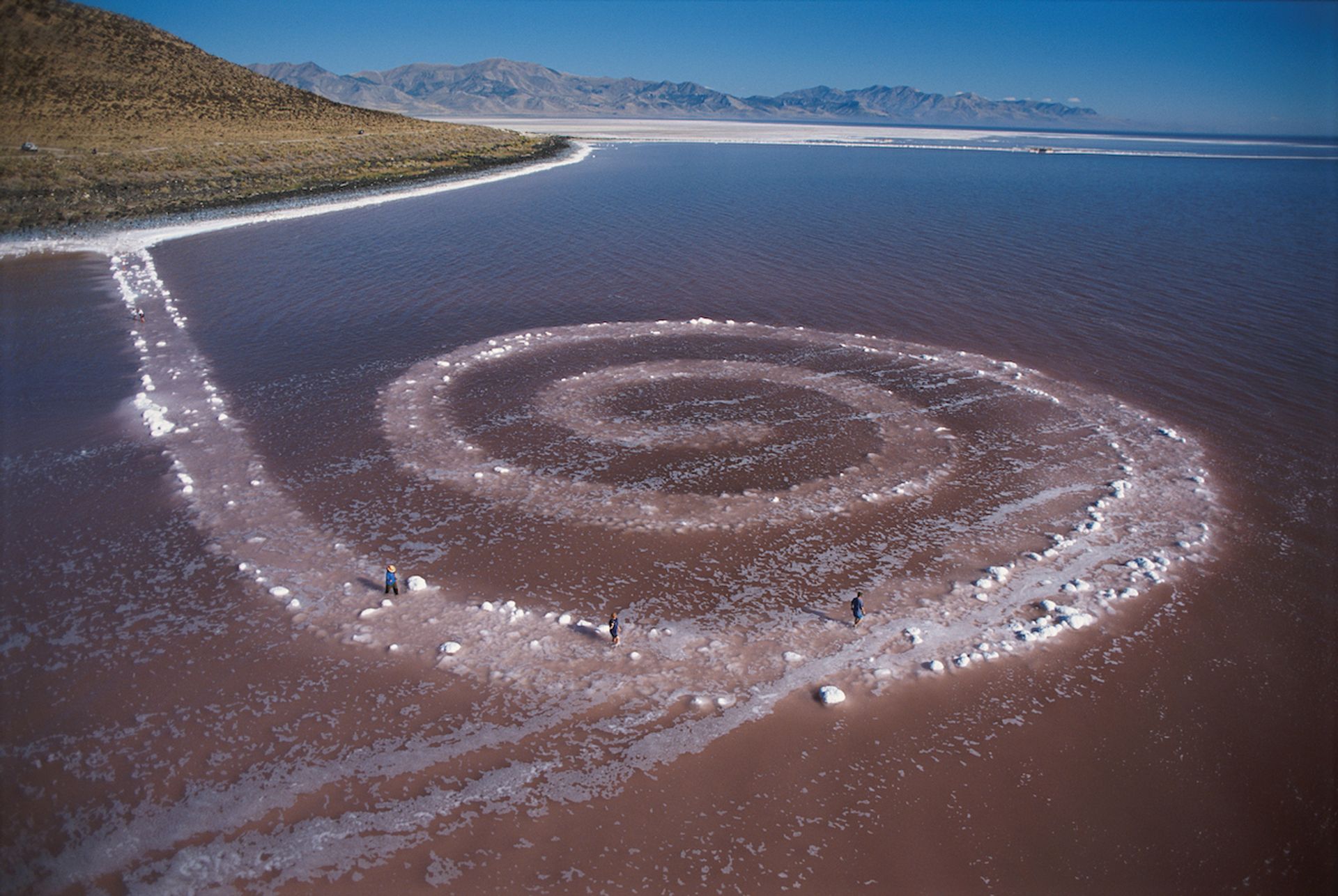
Robert Smithson, Spiral Jetty (1970) © Holt/Smithson Foundation and Dia Art Foundation/Licensed by VAGA at Artists Rights Society (ARS), New York. Photo: George Steinmetz, courtesy Dia Art Foundation, New York
Over the years information technology has expanded its collection, acquiring additional works past the 1960s and 1970s figures information technology first championed while embracing subsequently artists who mesh with a philosophy of putting viewers in touch with a wider reality.
When Morgan took over equally Dia's director in 2015 after serving as a curator at the Tate Modern in London, the foundation had relinquished its position every bit an art strength in Chelsea and was leasing its 22nd Street spaces to generate income. Dia Beacon, which had opened in 2003, had meanwhile risen in stature and was attracting enthusiastic young audiences with its mix of mammoth permanent installations like Richard Serra'south Torqued Ellipses (1996) and temporary viewings like a 2014-fifteen retrospective of Carl Andre's sculpture, poetry, works on paper and assemblages.
"When I started, my feeling was, we have these spaces" in New York City and "we need to effigy out exactly what we want to practise," Morgan says. "And why don't we do that through programming, so we can at least become a sense of what works we want and where we ultimately want to country?"
In addition to its three buildings on West 22nd Street, The Broken Kilometer and The New York Earth Room, the foundation's New York Urban center sites include Max Neuhaus's Times Square (1977), a sound piece of work on a pedestrian plaza in that area; and Joseph Beuys'due south 7000 Eichen (7000 Oaks), a serial of pairings of basalt stone columns and trees side by side to Dia Chelsea that have grown in number with the galleries' scheduled reopening.
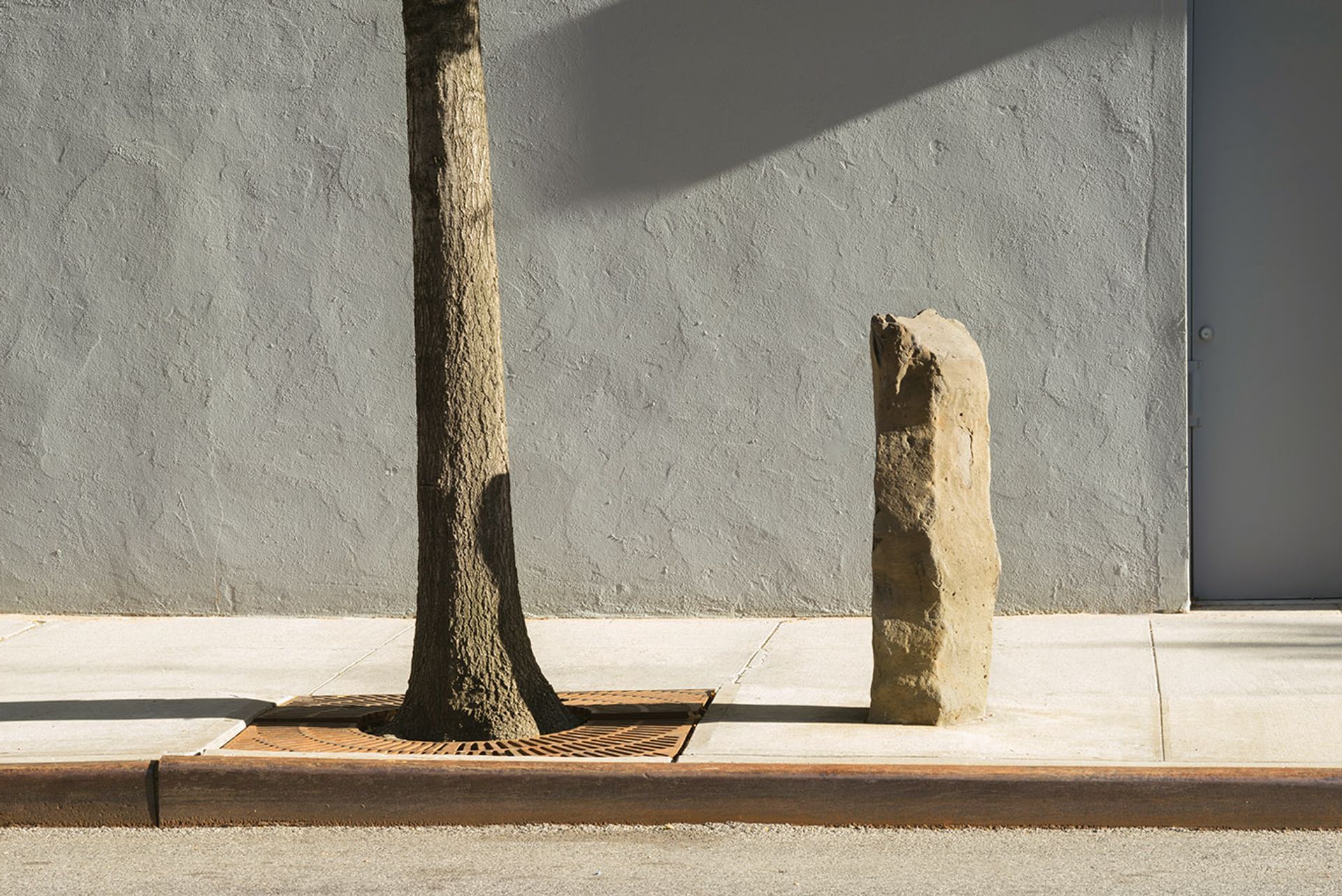
A pairing in Joseph Beuys, 7000 Eichen (7000 Oaks) © Joseph Beuys/Artists Rights
Morgan's reflections led to a series of artists' installations in the Chelsea galleries from 2016 to 2019, culminating in a viewing of Holt's Holes of Light (1973) and Mirrors of Lite 1 (1974) tied to Dia's acquisition of Sunday Tunnels. Then the galleries closed for the two-year renovation.
In the art world, "certainly, when I started, there had been this obsession about coming back to Chelsea, and about what was going on with Dia" afterwards the ascendancy of the Beacon outpost, Morgan says. "I recollect there was a lot of mystery nearly information technology. It was a bit of mystery to me, too. And to a large extent, I'd say those questions seem to evaporate, the more we're doing."
Linda Yablonsky, The Art Paper's contemporary art critic in New York, says Dia'south historic part all the same reverberates, decades after it cemented Chelsea's fine art world status in the 1980s and 1990s when many galleries were weighing a movement from SoHo.
"Its advantage over galleries and museums was that information technology could keep solo shows on view for an entire twelvemonth—a great luxury (as was the space of its building) that focused attention on each artist in a very particular manner," she says, referring to its earlier space across West 22nd Street. "The installations by Jenny Holzer, Robert Irwin, Robert Gober, Jessica Stockholder, Juan Muñoz, Richard Serra—I call back of all of these as high points in my life as a viewer."
For years, the governance of the Dia Art Foundation was uneven and at times contentious, with trustees sparring over goals and finances and directors abruptly departing. Yablonsky suggests that Morgan has put the organisation back on form by putting its renovation projects on a solid footing and mustering back up while also "correcting a serious imbalance of gender representation in the collection" through acquisitions.
It is notable that after Raven's installation, the side by side artists in the pipeline at Dia Chelsea are women besides: the US-built-in, Norwegian-based artist Camille Norment, known for her audio-based pieces, and Delcy Morelos, a Colombian sculptor who works in earthen materials and is attuned to ethnic culture.
De Gunzburg credits Morgan with forging cohesive goals that paved the style for the renovation and the plans for the SoHo and Beacon renovations. "Dia didn't accept a strong managing director for 10 years," she says. While Philippe Vergne, Morgan's predecessor, who held the post from 2008 to 2014, "was a very adept curator," she says, "you lot have to be a visionary. And Jessica is an incredible managing director."
"Information technology took her 1, two, iii years to wrap her caput about what she wanted for Dia, and when she did, nosotros were very happy with it."
Morgan says that while the Chelsea infinite has a crucial role to play in presenting artists, she as well hopes that information technology volition likewise be "incredibly important equally an informational hub" that illuminates what Dia'south other ten sites have to offer, peculiarly the costless New York locations.
"Our audition in Beacon is around lxx% under the age of 30, and it's very immature people who are coming from Queens and Brooklyn and Manhattan," she notes. "They're repeat visitors, and getting them to connect Dia Beacon with all of our other sites is important for u.s.a.. It's really wanting people to connect the dots."
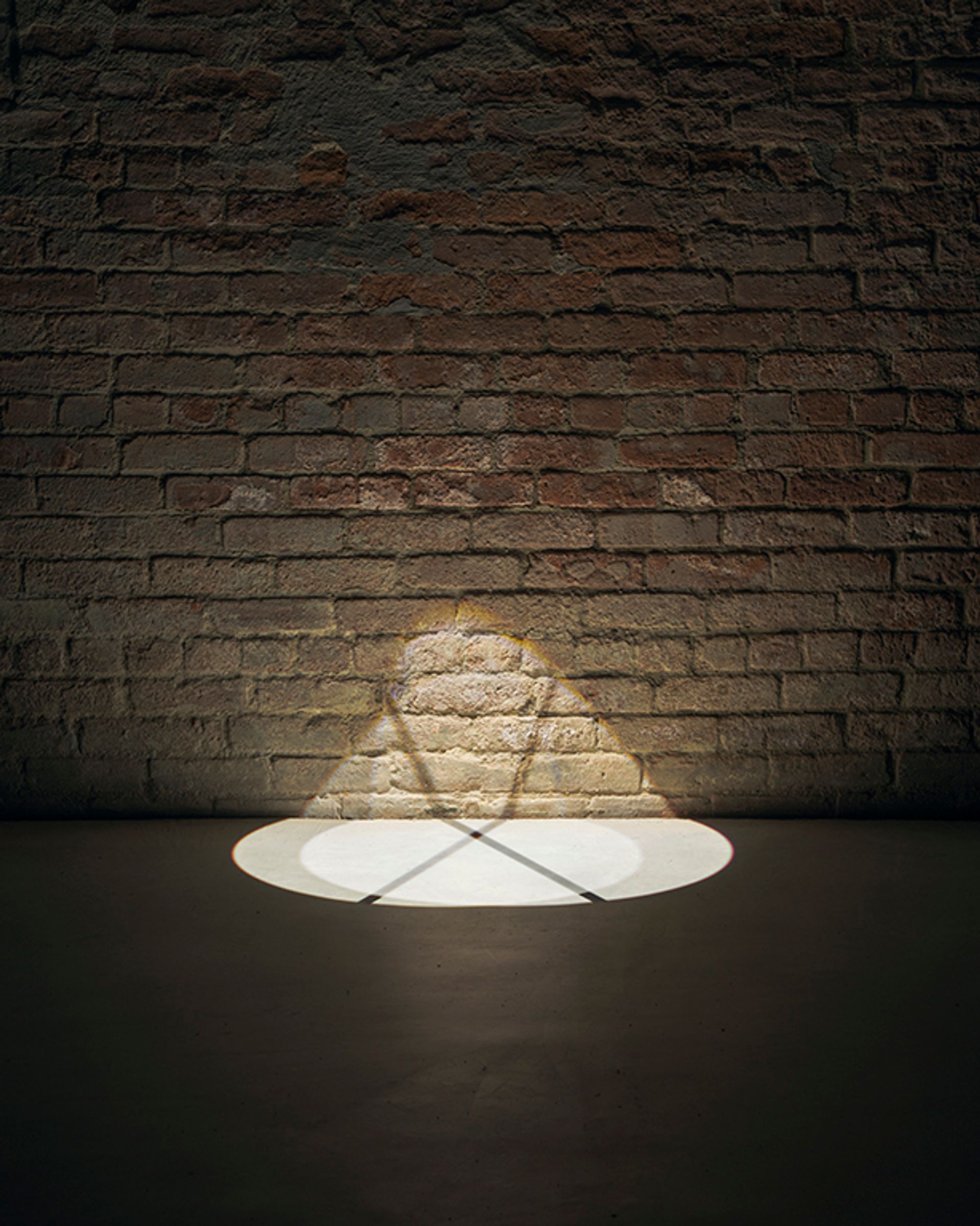
Lucy Raven, Casters Ten-ii + X-3, 2021 Photo: Bill Jacobson Studio, courtesy of Dia Art Foundation, New York
Source: https://www.theartnewspaper.com/2021/04/12/after-a-dollar20m-renovation-dia-is-poised-to-re-emerge-as-a-force-in-chelsea
0 Response to "How Many People Are Employed by Dia Art Foundation"
Postar um comentário